
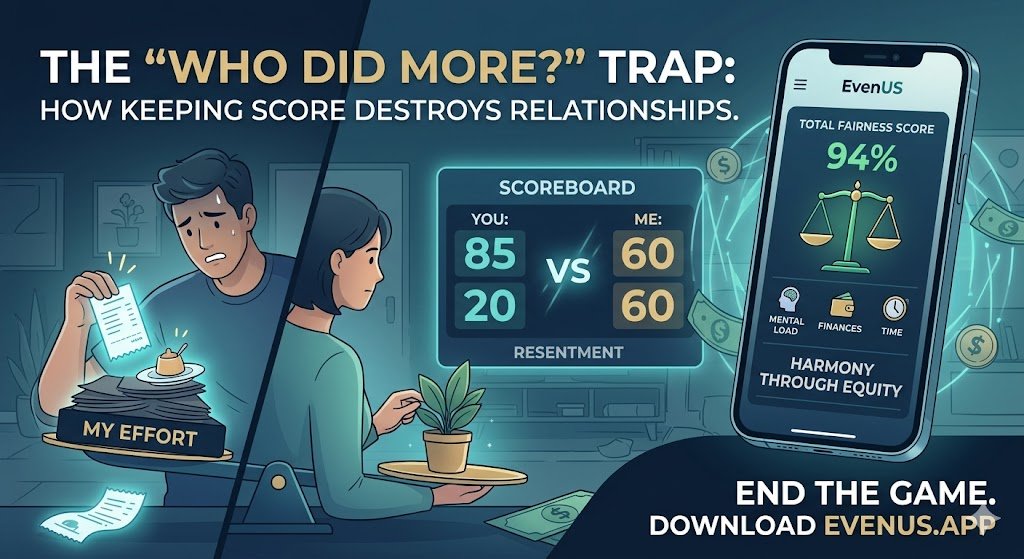
In the architecture of modern romance, there is a silent, corrosive termite that eats away at the foundation of even the most well-meaning couples: The Scoreboard. It begins innocently enough—a mental note that you were the one who emptied the dishwasher three times this week, or a subtle tally of who initiated the last three date nights. But over time, this habit of “keeping score” transforms a partnership from a sanctuary of mutual support into a high-stakes transaction where both players eventually lose.
To understand why the “Who Did More?” trap is so pervasive and how to escape it, we must look at the intersection of cognitive psychology, sociology, and the evolving nature of the modern household.
How Keeping Score Destroys Modern Relationships
1. The Psychology of Availability Bias: Why You Always Feel “Ahead”
The primary reason we feel we are doing more than our partner is not necessarily because they are lazy; it is because of a cognitive glitch known as Availability Bias.
In psychology, availability bias is the tendency to overestimate the importance or frequency of information that is “available” to your memory. You are 100% aware of every dish you wash, every stressful email you send to your child’s teacher, and every minute you spend navigating traffic to run an errand. You lived through the physical and emotional effort of those tasks.
Conversely, you only see a fraction of your partner’s effort. You don’t feel their mental fatigue. You don’t see the small logistical “fires” they put out while you are in another room. Research conducted by social psychologists has shown that when spouses are asked what percentage of the housework they contribute, the combined total almost always exceeds 120%. Both individuals genuinely believe they are carrying more than half the weight because their own labor is the most “available” data point in their brain.
2. The Fallacy of 50/50: Equality vs. Equity
The trap is often sprung by a fundamental misunderstanding of “fairness.” Most modern couples strive for Equality—the rigid, 50/50 split of all things. If I cooked tonight, you must clean tonight. If I spent $100 on groceries, you must Venmo me $50.
While this feels fair on a spreadsheet, it is disastrous in a relationship. Real life is not symmetrical. One partner may have a high-stress season at work, a family emergency, or a period of low physical energy. A “scorekeeper” views these fluctuations as a “debt” that must be repaid. This creates a Transactional Mindset, where service is rendered only when an immediate return is expected.
Healthy relationships thrive on Equity (fairness based on capacity) rather than equality (equal numbers). Equity recognizes that the “fair” split might be 80/20 for a month while one partner recovers from burnout. By insisting on 50/50 at all times, couples lose the “buffer” of grace that allows a partnership to weather life’s uneven terrain.
3. The Invisible Wall: Cognitive Labor and the Mental Load
Perhaps the most significant driver of the “Who Did More?” trap is the Mental Load. As research by Harvard sociologist Allison Daminger highlights, household management consists of four stages:
- Anticipating a need (realizing the dog needs a vet appointment).
- Identifying options (finding a vet with an opening).
- Deciding on a course of action.
- Monitoring the result.
The person who performs the physical task (taking the dog to the vet) often feels they did the “heavy lifting.” However, the person who handled the first three stages of cognitive labor is often more exhausted. Because cognitive labor is invisible, it is rarely recorded on the “mental scoreboard.” This leads to a cycle where one partner feels they are doing all the physical work, while the other feels invisible and burdened by the constant responsibility of “the plan.”
4. The “Parent-Child” Dynamic: When Scoring Leads to Resentment
When one partner feels they are consistently “ahead” on the scoreboard, a toxic shift in power occurs. They begin to adopt a “managerial” or “parental” role, checking up on the other partner’s tasks and offering “feedback” that feels like criticism.
The “indebted” partner, feeling they can never catch up or that their efforts aren’t recognized anyway, often reacts with Passive-Aggressive Resistance or “weaponized incompetence.” They stop trying to lead and wait to be told what to do. This reinforces the manager-partner’s belief that they have to do everything themselves, further fueling the “Who Did More?” fire.
5. Breaking the Cycle: From Competition to Collaboration
Escaping the trap requires a radical shift in how a couple views their “output.” Here are the research-backed frameworks to dismantle the scoreboard:
A. Assume Positive Intent
The most effective way to stop the “pinch” of scorekeeping is to start with the baseline assumption that your partner is your ally, not an adversary trying to slack off. When you see a task left undone, instead of thinking “They are lazy,” try thinking “They must be having a hard day; let me pick this up for us.”
B. Communicate the “Why,” Not the “What”
Scorekeeping conversations usually sound like: “I did the laundry, I did the dishes, and I picked up the kids. What did you do?” This is an interrogation. Equity-focused conversations sound like: “I’m feeling really overwhelmed by the household logistics this week and my tank is empty. Can we look at our ‘Shared Ledger’ and see where I can get some relief?”
C. Value the “Invisible”
Explicitly acknowledge the mental load. A simple “I know you handle all the meal planning and that’s a huge mental burden—thank you” can do more to dismantle a scoreboard than a dozen shared spreadsheets.
6. Automating Fairness: The Role of EvenUS
The reason most couples return to scorekeeping is that manual tracking is exhausting. When you have to remember who paid for what and who did what, the brain naturally defaults back to its “Availability Bias.”
This is where technology serves as a neutral peacemaker. The EvenUS app was built specifically to solve the “Who Did More?” trap by turning subjective feelings into objective, shared data.
- The Virtual Joint Ledger: Instead of “Venmo-ing” each other for every small expense—which maintains a “Roommate Vibe”—EvenUS tracks your shared spending automatically. You stay separate in your banking but unified in your math.
- Calculating the “Logistical Load”: EvenUS is the first platform that allows couples to log domestic labor and household management alongside financial contributions. It recognizes that “Time” and “Energy” are currencies just as valuable as “Money.”
- The Total Fairness Score: By synthesizing income-proportional splits with domestic labor, the app provides a neutral “Fairness Score.” It removes the need for one partner to be the “nag” or the “accountant.”
When a neutral system handles the math and validates the effort, the “Who Did More?” argument loses its oxygen.
Conclusion: The Goal is Not 50/50
In a truly thriving partnership, the goal is not to reach a state where both people do exactly half. The goal is a state of Mutual Generosity, where both partners feel that their contributions—whether financial, physical, or emotional—are seen, valued, and equitable.
By utilizing a “Virtual Ledger” mindset and leveraging tools like EvenUS, you can stop fighting over the math and start building a shared future. After all, the only way to win the game of relationship scorekeeping is to stop playing it.
You can find the live web demo, sample data, and mobile waitlist at the official homepage:
Availability Bias in Relationships:
- Study: Egocentric Biases in Availability and Attribution – This foundational study by Ross and Sicoly explores why spouses consistently overestimate their own contributions to household tasks.