
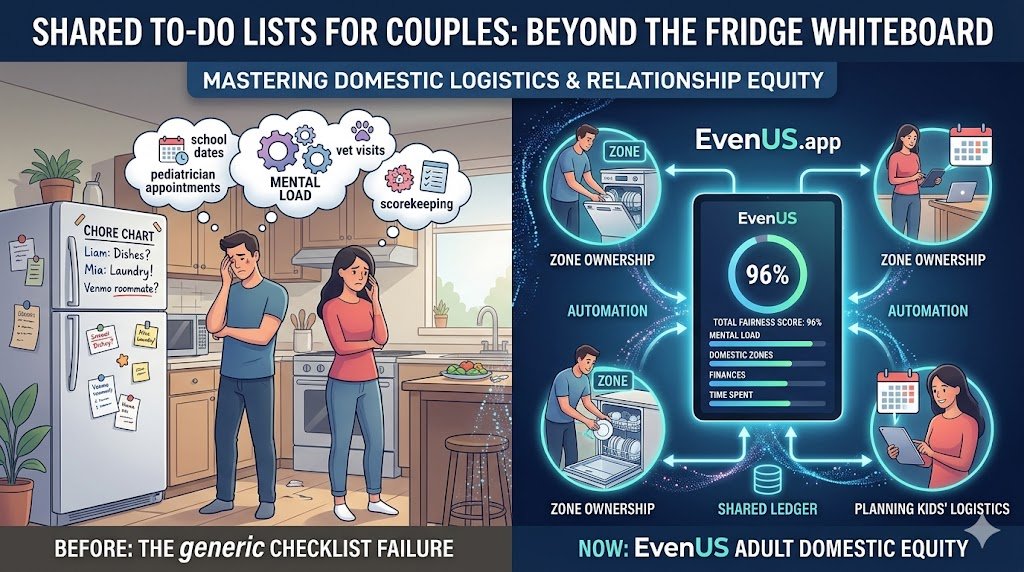
Shared To-Do Lists for Couples – The cycle is as predictable as it is frustrating. It usually begins on a Sunday evening with a tense argument over a forgotten grocery run, a missed utility bill, or the overwhelming feeling that one person is managing the entire house. In a desperate bid for domestic harmony, you and your partner agree to “get organized.” You open a standard, free productivity app—like Apple Notes, Google Keep, or a basic task manager—and create a shared folder triumphantly titled “House Stuff.”
For the first few days, there is a burst of productive dopamine. You check off boxes, you leave little notes for each other, and you assume the friction in your relationship has been permanently solved by a free download.
Three weeks later, the list is a digital graveyard. It is filled with unchecked boxes from half a month ago, passive-aggressive task assignments, and outdated grocery needs. You are right back to arguing, but now you carry the added guilt of failing to maintain the system you promised to use.
Why do shared to-do lists fail so spectacularly for romantic partners? It is because generic productivity apps are engineered for individuals executing linear tasks in a corporate setting. They are not built to handle the emotional, logistical, and financial complexities of a modern marriage. When you try to run a chaotic household on a basic checklist, you are attempting to fly a commercial jet using the dashboard of a golf cart.
If you want to permanently end the chore wars and build true relationship equity, you need a system engineered specifically for Co-CEOs. Here is an in-depth look at the five critical features your shared to-do list is missing, and why your partnership desperately needs them to survive.
Shared To-Do Lists for Couples: 5 Features You Didn’t Know You Needed
1. “Mental Load” Tracking: Validating the Invisible Work
The most fatal flaw of a standard shared to-do list is that it is only capable of measuring physical execution. It features a simple checkbox for an item like “Pick up dry cleaning,” “Buy dog food,” or “Schedule pediatrician.” What a standard list completely fails to measure is the exhausting cognitive labor required to put that item on the list in the first place.
Sociologists and psychologists refer to this as the “Mental Load.” It is the invisible project management of the home, consisting of anticipating needs, identifying solutions, and making executive decisions.
Imagine the task of buying winter coats for the children. If Partner A spends two hours inventorying the closets, researching which brands hold up best, checking the budget, and tracking down the right sizes, they have performed massive cognitive labor. If Partner B spends thirty minutes physically driving to the store to pick up the online order, a standard app gives Partner B 100% of the credit because they are the one who clicked the final checkbox. Partner A’s invisible labor goes completely unrecorded. Over time, the partner carrying the mental load burns out, feeling entirely unseen and unappreciated.
The Feature You Need: You need a platform that explicitly splits domestic tasks into “Planning” and “Execution.” Your system must allow partners to log the cognitive labor of project management. By validating the mental load, you ensure the planner gets tangible, visual credit for their invisible work, effectively ending the “I do everything around here” argument.
2. Zapier-Style Automation for Household Routines
Manual data entry is the enemy of long-term consistency. If your household management system requires you to sit down every single Sunday night and manually type out the same recurring chores, drag-and-drop task assignments, and rebuild your lists from scratch, you have not saved any time. You have simply traded physical chores for administrative chores. Adults thrive on automated workflows that reduce cognitive friction; if the system is tedious, you will abandon it.
You need to apply a “Zapier” mindset to your domestic life, where a trigger in one area automatically generates an action in another, without requiring human intervention.
The Feature You Need: Your shared app should operate on dynamic triggers and recurring logic. If the HVAC air filter is changed and checked off today, the system should automatically regenerate the task and assign it for 90 days in the future. If the dog is given a monthly heartworm pill, the next dose should automatically populate on the calendar. You need a system that manages the schedule for you, sending automated, neutral nudges to both partners. When the app does the reminding, you never have to act as your partner’s nagging project manager again.
3. Zone Ownership (Instead of Micro-Task Delegation)
A standard to-do list encourages micro-management. It breaks life down into tiny, isolated chores: fold the towels, chop the onions, take out the recycling, wipe the counters.
This creates a toxic dynamic where one partner inevitably becomes the “Manager,” assigning out individual tasks, and the other becomes the “Intern,” waiting for instructions and doing exactly what is asked—but nothing more. When you are dealing with the dense, overlapping logistics of a growing family, micro-managing individual tasks shatters under the pressure.
Consider the sheer complexity of managing the educational and medical logistics of three children. If you are trying to advocate for twins to be placed in different school sections next year, while simultaneously tracking a six-year-old’s soccer schedule, pediatric dental appointments, and weekend playdates, you cannot simply put “manage kids” on a to-do list. The logistics require total immersion and context.
The Feature You Need: Your system must support the concept of Zone Ownership. Instead of assigning fifty individual chores a week, you need the ability to assign complete, overarching domains (e.g., “Kids’ Logistics,” “Kitchen & Nutrition,” “Auto & Exterior Maintenance”). When a partner owns a Zone, they own the entire vertical from planning to execution. The app should visually represent these domains, making it crystal clear who holds the ultimate executive authority over which parts of your shared life.
4. An Integrated Virtual Ledger for Shared Finances
Household logistics and household finances are inextricably linked. You cannot separate the physical act of running an errand from the financial act of paying for it. Yet, most couples try to manage these two things in completely separate silos.
If Partner A does the grocery shopping, picks up the kids’ prescriptions, and pays the plumber, checking those boxes on a standard to-do list does absolutely nothing to balance the bank account. Couples are then forced to cross-reference their task list with a separate financial spreadsheet, calculating who owes what, and sending highly transactional Venmo requests to each other at the end of the month to “settle up.” This inherently turns romantic partners into debt collectors and accountants. Furthermore, simple 50/50 splits often create deep financial inequity if partners earn vastly different incomes.
The Feature You Need: Your task manager must be directly integrated with a virtual financial ledger. When a household task involves an expense, logging the completion of that task should seamlessly sync to your shared finances. The ideal system calculates dynamic, income-proportional splits in the background. It ensures that both the physical labor of the errand and the financial burden of the receipt are balanced simultaneously, in real-time, without either partner having to ask for money.
5. The “Total Fairness” Dashboard
Because of a psychological glitch called Availability Bias, human beings are neurologically wired to overestimate their own contributions to a household and vastly underestimate their partner’s. Because you physically experience your own fatigue, you remember every single dish you wash, every floor you sweep, and every stressful phone call you make. Conversely, you are completely blind to the emails your partner sends to the school district while you are at work.
If you rely on your human memory to judge whether your relationship is “fair,” you will always feel cheated. A standard list of checked and unchecked boxes does not provide a macro-level view of relationship equity; it just shows you what is done and what is pending.
The Feature You Need: You need a neutral, data-driven dashboard that synthesizes the entire reality of your partnership. Your app should take the physical tasks completed, the invisible mental load carried, the time spent managing Zones, and the proportional financial contributions made, and roll them into a single, unified metric—a Total Fairness Score. When you can open an app and objectively see that the holistic household load is split fairly, the scoreboard anxiety vanishes. The data speaks for itself, preventing arguments before they even begin.
Stop Using Roommate Tools for a Co-CEO Partnership
Attempting to manage a modern marriage with a basic checklist app is a recipe for burnout and resentment. A piece of digital scratchpad paper cannot validate the mental load, automate your routines, or balance your bank accounts. You need a tool engineered specifically to handle the heavy, overlapping realities of love, logistics, and money.
This is the exact architecture and philosophy behind EvenUS. Built exclusively for couples, EvenUS goes far beyond the basic checkbox. It is the only platform designed from the ground up to track the invisible mental load, establish clear Zones of Ownership, and automate your shared financial ledger. By synthesizing your time, money, and cognitive effort into a dynamic, real-time Total Fairness Score, EvenUS eliminates the friction of manual scorekeeping.
Upgrade your systems, protect your romantic energy, and ditch the generic to-do list for a platform built for true partners.
If you want to truly understand why checking a box doesn’t solve the core issue of domestic burnout, read Harvard sociologist Allison Daminger’s groundbreaking research on The Cognitive Dimension of Household Labor (or read the free JSTOR summary here) to see exactly why the “mental load” is a scientifically recognized form of work.
Once you realize that a basic notepad app cannot validate that invisible labor, it is time to upgrade your system. Stop relying on generic productivity tools to fix a relationship problem. Track the mental load, automate your shared finances, and master your zones of ownership with a platform built specifically for Co-CEOs.