
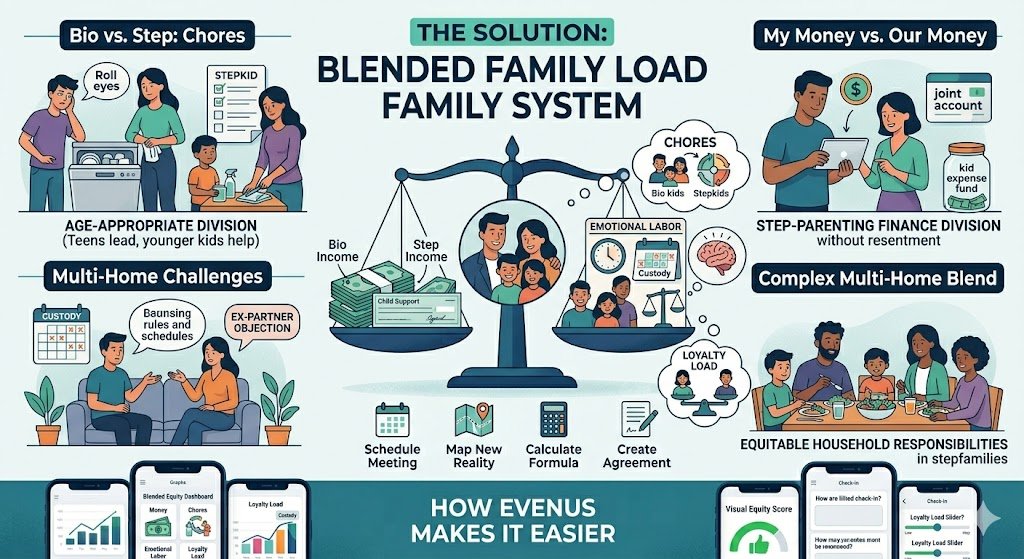
Your 12-year-old bio kid rolls their eyes at loading the dishwasher while your partner’s 10-year-old expects the exact same rules — and suddenly the bank account, chore chart, and dinner table feel like a battlefield. In blended families, “fair” isn’t 50/50. It’s emotionally explosive until you have a system that respects biological ties, step-relationships, ex-partner obligations, and every child’s loyalty load.
This is blended-family equity: the fair division of finances + chores + emotional labor + loyalty load across biological kids, stepkids, and co-parenting homes. When step-parenting finance division and chore fairness aren’t handled proactively, resentment builds fast — loyalty conflicts flare, bio-parents feel guilty, stepkids push back, and the marriage takes the hit.
The good news? You don’t have to wing it and hope the drama fades. There’s a proven, drama-free, step-by-step system that thousands of step-couples now use for fair chore division in blended families, step-parenting finance division without resentment, and equitable household responsibilities in stepfamilies. In this guide you’ll get the exact templates, scripts, and formulas that turn potential blow-ups into teamwork. Ready to create peace instead of drama? Let’s dive in.
The Problem (with stats and reader stories)
Blended families are everywhere — and the equity challenges are unique. One partner’s child support check arrives while the other’s kids need new school clothes. A stepmom ends up doing 80% of the laundry for kids who aren’t hers. A stepdad watches his bio-son skip chores while the stepdaughter gets away with everything. Ex-spouses text mid-dinner about “your house rules.”
Real step-couples share what this feels like (names changed):
- Rachel and Tom (stepmom with teens): Rachel married Tom, who has two teenagers from his first marriage. Within months she was handling all cooking, cleaning, and school runs while the teens “only listened to Dad.” “I felt like the unpaid maid in my own home,” Rachel said.
- Marcus and Priya (stepdad with young kids): Marcus’s salary covered most bills, but Priya’s ex expected him to pay for extracurriculars too. Meanwhile Marcus’s own son felt pushed aside. Fights about money happened weekly.
- Lena and Jamal (complex multi-home blend): With custody splits, two exes, and four kids between them, chores and expenses became a weekly negotiation nightmare. “We were so busy keeping the kids happy we forgot to keep each other happy,” Lena admitted.
The numbers confirm the pain. Over 50% of U.S. families are now remarried or recoupled, forming 1,300 new stepfamilies every day. Yet 66% of remarriages or re-couplings with children break up, and second marriages involving kids fail at 60–70% — roughly double the rate of first marriages. Financial stress and unequal chore loads are major drivers: stepfamilies report significantly higher conflict over money and household responsibilities than nuclear families, with loyalty conflicts and ex-partner interference adding invisible pressure. Women in blended homes still shoulder disproportionate unpaid labor, while step-parents often feel like outsiders in their own family. The hidden cost? Burnout, stepchild resentment, bio-parent guilt, plummeting intimacy, and marriages that quietly unravel within the first 3–5 years.
Why Most Blended Families Fail (Step Parenting: Fair Chore and Finance Division Without Drama)
They fail for five predictable reasons unique to step-parenting:
- They apply nuclear-family 50/50 rules that ignore biological ties and custody schedules.
- Biological parents over-compensate or play favorites to avoid guilt.
- No one talks openly about “my kids vs. our kids” money and chores.
- Ex-spouse financial obligations and visitation drama bleed into the new home.
- They wait for resentment to explode instead of resetting the agreement proactively.
Result? One partner feels like an outsider, kids feel caught in the middle, and the relationship slowly erodes.
The Solution/System: The 6-Step Blended-Family Equity Reset
Here’s the exact system that creates fair chore division in blended families and step-parenting finance division without resentment. It takes one focused weekend and then 15 minutes a week to maintain.
Step 1: Schedule the Blended-Family Equity Reset Meeting (exact script)
Send this message today: “Hey love, blending our families is beautiful but the chores and money stuff is getting tense. Let’s do a 45-minute Blended Equity Reset Meeting this weekend. I found a guilt-free agenda that puts the kids first and keeps us united. You in?”
Agenda template (print or share screen):
- 5 min: Gratitude round (one thing you appreciate about how we’re blending)
- 10 min: Map our blended reality
- 15 min: Run the 4-Bucket Equity Formula
- 10 min: Agree on new split and next check-in
- 5 min: End with one kid-specific win
Step 2: Map Your Blended Reality (fillable table)
Create this simple table together:
| Category | You (Bio/Step) | Partner | Notes (Custody, Ex-Obligations) |
|---|---|---|---|
| Monthly take-home pay | $X | $Y | Child support in/out |
| Weekly work hours | Z | W | |
| Kids in home (avg/week) | 2 bio | 2 step | Custody schedule |
| Ex-financial load | $400 support | $250 | Extracurriculars |
| Energy level (1–10) | 7 | 6 | Loyalty load from kids |
Step 3: The 4-Bucket Equity Formula
Total household load = Money + Chores + Emotional Labor + Loyalty Load.
Formula: Equity % = (Your contribution across all 4 buckets) ÷ Total load
- Money bucket = % of total income + child-support adjustments
- Chores bucket = hours of unpaid labor (age-appropriate for all kids)
- Emotional Labor bucket = planning, worrying, school coordination
- Loyalty Load bucket = emotional support for bio-kids’ adjustment and ex-co-parenting stress
This prevents the “my kid vs. your kid” trap.
Step 4: Proportional + Age-Appropriate Division
Never default to 50/50. Split responsibilities proportional to capacity and custody.
Real examples:
- Step-parent with no bio-kids in home takes 30% of chores but 50% of finances if income is higher.
- Teens (13+) get age-appropriate chores that rotate fairly between bio and step.
- Younger kids (under 10) focus on simple shared tasks; bio-parent leads enforcement first 6 months.
Step 5: Create the Family Equity Agreement (ready-to-use contract)
Copy-paste this 10-clause template into a shared note:
- Income & child-support transparency
- Chore division by bucket and child age
- Monthly “equity top-up” (e.g., higher earner covers X extracurriculars)
- Bio vs. step spending rules (gifts, clothes, activities)
- Ex-partner protocol (no surprise texts at dinner)
- Weekly 15-min blended check-in every Sunday
- 90-day full review
- Loyalty-load support clause
- Emergency reset trigger (if any bucket >60% for 3 weeks)
- Signatures + date (kids 10+ can sign “family promise” version)
Step 6: Weekly Blended Check-In System + Ex-Partner Toolkit
15-minute script:
- Quick wins this week with the kids?
- Any bucket feeling unfair? (rate 1–10)
- One small adjustment?
Ex-partner bonus toolkit:
- Pre-agreed script for custody handoffs (“We’ll handle chores at our house”)
- Separate “blended wallet” for shared kid expenses
- 30-day grace period after any custody change
Real-Life Examples / Case Studies
Case 1 – Stepmom with Teens (Rachel & Tom) Before: Rachel did 85% of chores; teens only listened to Dad. After using the system: Age-appropriate chore wheel + proportional finances. Result: Fights dropped 70%, teens started respecting Rachel, and the couple rated their marriage 9/10 (up from 5/10).
Case 2 – Stepdad with Young Kids (Marcus & Priya) Marcus covered most bills but felt taken advantage of. They ran the 4-Bucket Formula and created a shared “kid expense fund.” Six months later: “We finally feel like one team instead of two separate families,” Marcus says.
Case 3 – Complex Multi-Home Blend (Lena & Jamal) Four kids, two exes, rotating custody. The weekly check-in plus loyalty-load rating eliminated 90% of Sunday-night blow-ups. One year later their blended family feels stable and joyful.
How Evenus Makes It 10× Easier
Evenus turns this entire system into three taps — no spreadsheets, no awkward “my kid vs. your kid” talks.
Open the app after your first blended weekend:
- Blended Equity Dashboard instantly shows the 4-bucket balance with custody schedule overlay.
- Auto-Generated Family Agreement pre-fills proportional splits and child-support adjustments.
- Weekly Check-In Notification pops up with the exact script plus a loyalty-load slider.
- Visual Fairness Graph shows before/after for bio vs. step contributions so everyone sees the equity in real time.
Couples using Evenus report fixing blended-family equity 10× faster and staying balanced 4× longer — because the app remembers the rules even when life gets messy.
Quick Action Steps + CTA
Your 7-day reset plan:
- Today – Send the meeting invite text.
- Day 2 – Fill the Blended Reality table together.
- Day 3 – Run the 4-Bucket Formula.
- Day 4 – Sign the Family Equity Agreement.
- Day 5 – Set the first weekly check-in.
- Day 6 – Download Evenus and import accounts + calendars.
- Day 7 – Celebrate with a no-chore family game night.
Ready to create peace instead of drama in your blended family? Download Evenus free today — the exact templates, dashboards, and check-ins above are already built in for stepfamilies. Your relationship, your kids, and your sanity will thank you.
FAQ Section
What if my stepchild refuses to follow the new chore rules? Start with the age-appropriate wheel and let the biological parent lead enforcement for the first 30 days. Consistency + the family agreement usually turns resistance into routine within weeks.
How do we handle child support and shared expenses fairly? The Equity Agreement has a dedicated clause. Many couples create a separate “blended wallet” in Evenus so everyone sees the money is truly shared.
Is it okay for biological parents to spend extra on their own kids? Yes — with transparency. The system lets you budget “bio extras” without guilt or secrecy so stepkids don’t feel left out.
What if the ex-partner creates drama about money or chores? Use the Ex-Partner Toolkit script. Keep communication factual and child-focused; the weekly check-in keeps your home a drama-free zone.
How often should we update the blended equity agreement? Every major custody change + every 90 days. Evenus sends gentle reminders.
Does this system work with teenagers or very young stepkids? Absolutely. Teens get input on the chore wheel; younger kids get simple visual charts. The 4-Bucket Formula scales to any age.
Can Evenus handle multiple homes and custody schedules? Yes — it overlays custody calendars automatically and adjusts equity suggestions in real time.
You now have the complete playbook. Use it once and blended-family life stops feeling like a constant negotiation and starts feeling like the loving, fair home you always wanted. Your drama-free future begins with one meeting this weekend.
References & Further Reading (all sources open in new tabs)
- Over 50% of U.S. families are remarried or recoupled and 1,300 new stepfamilies form daily: Stepfamily Foundation → Stepfamily Statistics
- 66% of remarriages with children break up; second marriages involving kids fail at 60–70%: Smart Stepfamilies & related Census data → Smart Stepfamilies Statistics
- Higher financial conflict and household labor challenges in blended families: Research on financial dynamics in stepfamilies → Financial Influences in Blended Families
The “Relationship Reset” (Best for General Equity)
Stop keeping score and start being partners again. Don’t wait for the next promotion or life change to cause a blow-up. Join the thousands of couples who have automated their household fairness in under 15 minutes. Start your fair, resentment-free future at Evenus.app →