
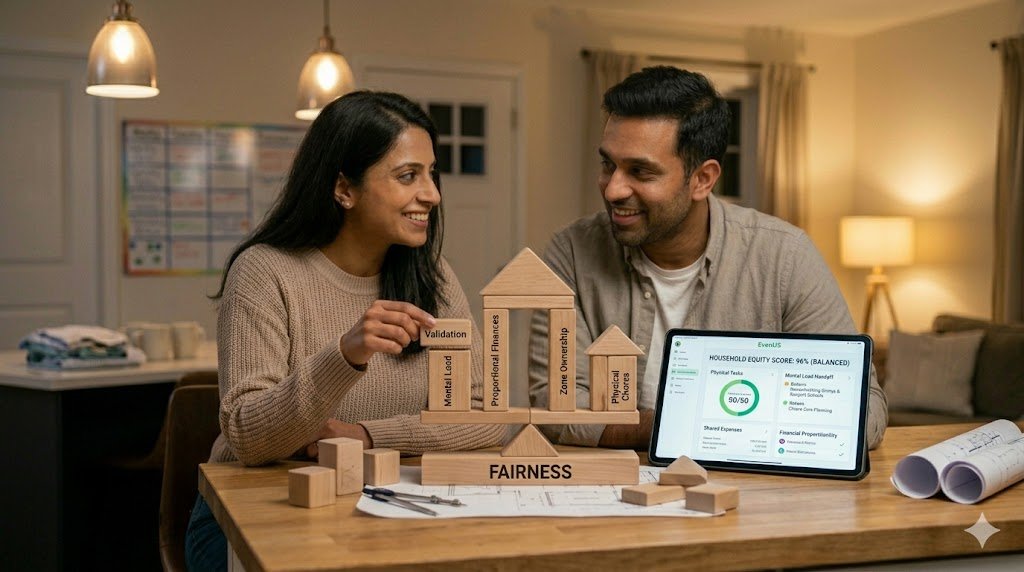
The Architecture of a Personalized Marriage- Walk into any bookstore or open any social media app, and you will immediately be bombarded by a thriving industry of organization experts, bestselling authors, and lifestyle influencers. They all promise the ultimate, universal secret to a perfectly managed, stress-free home. They offer standardized chore charts, beautifully color-coded printable calendars, and rigid, minute-by-minute daily routines guaranteed to bring peace to your domestic life.
But when you are operating in the trenches of a high-density modern marriage, generic, off-the-shelf household advice is not just unhelpful—it feels entirely insulting.
When you are trying to manage the overlapping, chaotic schedules of a highly energetic six-year-old alongside the rapid developmental milestones of growing twins like Ananya and Rihaan, all while balancing two demanding professional careers, a magnetic chore wheel on the refrigerator is a hopelessly inadequate tool. You cannot take a standardized household management system designed for a single-income 1950s nuclear family and force it onto a dual-income partnership in the modern era.
Every single romantic relationship possesses a completely unique financial architecture, a unique threshold for domestic mess, and a highly specific distribution of available time and cognitive energy. If you want to end the exhausting cycle of logistical arguments, you do not need to try harder to fit into someone else’s mold. You need to design a personalized, data-driven system built specifically for the realities of your own life.
Here is the comprehensive, step-by-step framework for designing a bespoke household management system that actually protects your peace and your partnership.
The Architecture of a Personalized Marriage: Designing a Fair Household System That Actually Works
Phase 1: The Blueprint (Defining Your Household Variables)
You cannot build a sustainable system—whether it is a software application or a marriage—until you honestly and objectively assess the materials you are working with. A personalized household system requires a ruthless, blameless audit of your specific household variables.
1. Negotiate Your “Minimum Viable Standard” (MVS) Most domestic arguments do not actually start because a chore was left undone; they start because partners have completely different definitions of what constitutes a “clean” or “managed” home. You must actively negotiate your Minimum Viable Standard (MVS) for every room and major routine.
Does the kitchen need to be spotless, wiped down, and sanitized before bed, or is a soaked pan left in the sink acceptable until the morning? Does the laundry need to be folded and put away immediately, or can it live in a clean basket in the corner of the bedroom for two days?
The Golden Rule of the MVS: Once you mutually agree on the minimum standard for a specific task, the partner with the naturally higher standard must permanently surrender the right to nag, critique, or sigh heavily if the MVS is met. If you want it done beyond the MVS, you must own that zone yourself.
2. Audit the Total Available Bandwidth A fair system acknowledges the mathematical reality of your lives. How many hours does one partner work outside the home versus the other? Does one partner have a grueling hour-long commute while the other works remotely from a home office? Who has a higher biological threshold for sleep deprivation when the kids are sick?
You must map out the actual hours of cognitive and physical energy available to the household each week. You cannot demand equal output from unequal bandwidth.
3. Quantify the Unique Mental Load Every family has a drastically different administrative burden. Before you even discuss who is going to push the vacuum, you must list the invisible labor required to run your specific lives. Who researches the local pediatricians and dog vet experts? Who coordinates the extracurricular drop-offs? Who remembers to buy the extended family birthday gifts? This invisible cognitive labor takes up massive amounts of mental “RAM” and must be explicitly quantified and placed on the table before any physical chores are divided.
Phase 2: Building the Architecture (The Rule of Proportional Equity)
Once you deeply understand your unique household variables, it is time to distribute the weight. The absolute foundation of a personalized system is the complete rejection of the “50/50 split.”
The Danger of Forced Equality Attempting to split every expense and every chore perfectly down the middle is a toxic pursuit that will build a fragile system guaranteed to shatter under pressure.
If there is a significant income disparity between you and your partner, a strict 50/50 financial split breeds quiet resentment, restricts autonomy, and creates immense financial anxiety for the lower-earning partner. Similarly, if there is a disparity in working hours—say, one partner works 55 hours a week while the other works 35—demanding a 50/50 split of the evening childcare and dishes guarantees severe burnout for the overworked partner.
Implementing Proportional Equity A personalized, modern system utilizes Proportional Equity. You divide the responsibilities based on the mathematical realities of your audit.
- Financial Proportionality: If you earn 65% of the total household income, your system should be designed so that you comfortably cover 65% of the shared domestic expenses.
- Labor Proportionality: If you have 30% more unstructured free time in your week, you should take on a proportionally larger share of the physical task execution.
The ultimate success metric of a personalized system is not that both partners scrubbed the exact same number of toilets. The metric of success is that at the end of the week, both partners experience the exact same amount of unstructured free time and financial breathing room.
Phase 3: Operational Management (The Shift to Zone Ownership)
The fastest way to break your newly designed, personalized system is to rely on delegation.
If one partner has to constantly tell the other what to do, they are still carrying 100% of the mental load of project management. They are acting as the Household Manager, while their partner acts as the Intern. To run your home like a modern enterprise, you must transition to Zone Ownership using the Conception, Planning, and Execution (CPE) model.
Instead of assigning individual, disconnected tasks based on a generic printable list, assign entire “Zones” based on your personal strengths, preferences, and available bandwidth.
- Does one partner genuinely enjoy cooking but absolutely hate navigating the grocery store? They own the “Kitchen Execution Zone.”
- Is one partner highly organized and detail-oriented? They own the “Family Logistics, School, and Calendar Zone.”
When you own a zone, you own it entirely from the very first thought to the final follow-through. You operate as the fully capable Co-CEO of that department, and your partner completely removes it from their cognitive load.
Phase 4: The Digital Infrastructure (Systematizing the Peace)
You can have the most brilliant, equitable, and personalized blueprint in the world, but if you try to manage it using analog tools, the system will eventually fail.
Trying to track proportional equity, zone ownership, and the mental load using a whiteboard on the fridge, a scattered string of text messages, or a chaotic series of Venmo requests is a recipe for disaster. Analog tools rely entirely on flawed human memory. They require constant verbal check-ins, which quickly devolve into nagging, which inevitably leads right back to the resentment you were trying to escape.
A truly personalized, modern household management system requires a dedicated, digital infrastructure. In your professional life, you use software to automate complex workflows and keep your team aligned. Your home—the most important organization you will ever run—deserves the exact same level of operational respect.
By moving your agreements, your proportional math, and your zone assignments into a couple-oriented digital platform like EvenUS, you effectively hire a digital project manager.
The application does not care whose turn it is to be tired; it simply tracks the objective data. It allows you to automatically calculate your proportional financial splits in the background, completely removing the tension of monthly money talks. It allows both partners to log their invisible “mental load” hours, validating the cognitive labor that usually goes unseen.
When you let software handle the exhausting administrative tracking, you remove the emotional friction from your daily logistics. You stop trying to manage each other, you end the weekly chore wars, and you finally get back to the business of being romantic partners.
A personalized household system only survives if you have the right digital infrastructure to maintain it. Trying to manage proportional equity and the mental load with sticky notes and text messages is a guaranteed path back to frustration. EvenUS is the digital dashboard engineered strictly for couples—not roommates or students—to seamlessly track physical chores, validate your unique mental load, and automate proportional shared finances. Build a system that actually works for your exact life. Start designing your digital partnership today at EvenUS.app
The absolute necessity of tailoring your domestic approach to your specific reality is heavily supported by family sociology and psychology. According to clinical research highlighted by the American Psychological Association (APA), one of the primary drivers of marital conflict is the failure to adjust household expectations to match the reality of external stressors, such as demanding careers, financial shifts, or raising multiple children. When couples force a rigid, standardized chore routine onto a dynamic, high-stress life, they actively erode their emotional connection and invite burnout.