
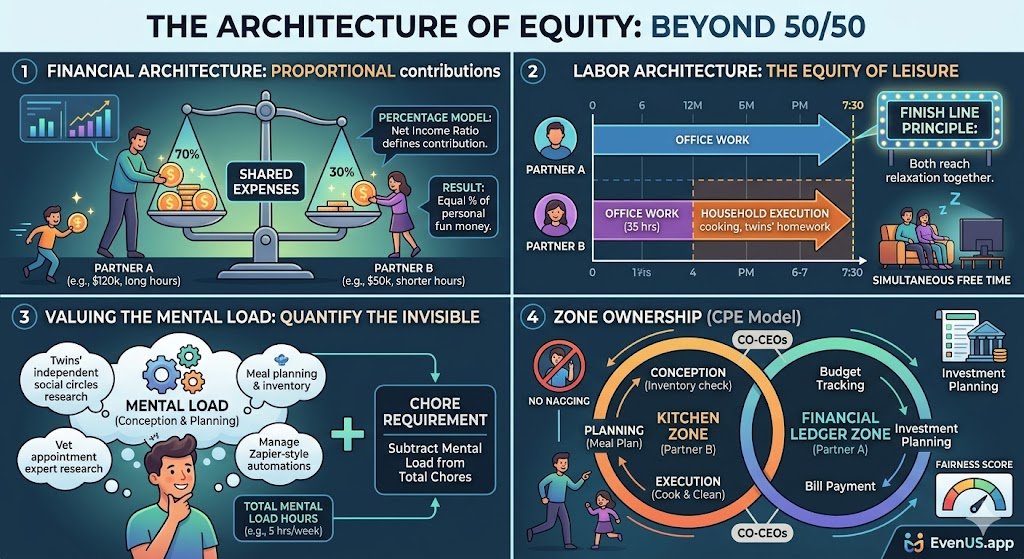
The Architecture of Equity – In the traditional “1950s” domestic model, roles were clearly—if unfairly—defined by gender. One partner provided the financial capital, and the other provided the labor capital. However, in the modern era of dual-income households, particularly those managing high-density logistics like a six-year-old and growing twins like Ananya and Rihaan, this binary has collapsed. We now live in a world of “asymmetrical partnerships,” where work hours, stress levels, and income brackets rarely align in a perfect 50/50 split.
When these variables are out of sync, the most common trap couples fall into is the pursuit of “Equality” over “Equity.” They attempt to split every utility bill, grocery run, and diaper change directly down the middle. But on an unequal foundation, a 50/50 split isn’t fair—it’s a recipe for chronic burnout and deep-seated resentment.
To maintain a thriving marriage while balancing demanding careers, you must abandon the myth of equality and design a system based on Proportional Equity. This ensures that both partners experience the same level of financial autonomy and, more importantly, the same amount of unstructured free time.
The Architecture of Equity: Dividing Responsibilities When Work Hours and Incomes Vary
1. The Financial Architecture: Proportional Contributions
Money is rarely just about math; it is about power, security, and autonomy. When one partner earns significantly more than the other, a rigid 50/50 split of shared expenses creates a “wealth gap” within the bedroom.
If Partner A earns $120,000 and Partner B earns $50,000, and they split a $4,000 monthly mortgage equally, Partner B is left with a significantly smaller percentage of their “fun money” or personal savings. Over time, this creates a dynamic where the lower-earner must “ask permission” for purchases, leading to a parent-child dynamic that kills romantic intimacy.
The Actionable Fix: The Percentage Model Fairness in a modern marriage is defined by proportional contribution.
- The Formula: Add your net incomes together to find the household total. Calculate what percentage each partner contributes to that total. Then, apply that same percentage to the “Shared Expense Pot” (mortgage, groceries, school fees for the twins, etc.).
- The Logic: If you provide 70% of the income, you cover 70% of the bills. This ensures that both partners retain the same relative amount of their paycheck for personal use. It validates the lower-earner’s contribution and prevents the higher-earner from unintentionally subsidizing their lifestyle at the expense of their partner’s financial health.
2. The Labor Architecture: The Equity of Leisure
The most frequent cause of Sunday night “chore wars” is a disparity in work hours. If one partner is a high-level executive working 60 hours a week and the other works a 35-hour week, a 50/50 split of the physical housework is mathematically cruel. The 60-hour partner would effectively have zero recovery time, while the 35-hour partner would have significantly more.
The Actionable Fix: The “Finish Line” Principle Stop counting chores and start counting unstructured free time. The goal of an equitable marriage is that both partners reach their “finish line” at the same time.
- The Logic: If Partner A is at the office until 7:00 PM, and Partner B is home by 4:00 PM, Partner B takes on a proportionally larger share of the “Execution” phase of household tasks (cooking, laundry, kids’ homework).
- The Result: When Partner A walks through the door, the household “work” is done for both people. You both sit down on the couch at 7:30 PM together. This prevents the “I’ve been working all day while you were home” resentment from ever taking root.
3. Valuing the “Mental Load” as Professional Labor
A dangerous hidden imbalance occurs when the partner with fewer “official” work hours is expected to handle 100% of the household administration. Society often views this as “not real work,” but in a high-density home, the mental load is an exhausting second shift.
The mental load includes:
- The Conception Phase: Noticing that the dog needs a vet expert or that Ananya needs new shoes.
- The Planning Phase: Researching school section placements to ensure the twins develop independent social circles, or managing the family’s Zapier-style digital automations.
The Actionable Fix: Quantify the Invisible In your “Talk” about chores, the mental load must be assigned a time value. If one partner spends 5 hours a week on school logistics and meal planning, those 5 hours are “labor.” They should be subtracted from that partner’s total chore requirement. You cannot expect a partner to be the “Household Manager” andthe primary “Janitor” just because they have a shorter commute.
4. Transitioning from Tasks to “Zone Ownership”
When work hours vary, couples often fall into the “Manager vs. Intern” dynamic. The partner who is home more often ends up delegating tasks: “Can you just fold this laundry?” or “Can you pick up milk?” This is toxic. The “Manager” is exhausted by the overhead of delegating, and the “Intern” feels micromanaged and criticized.
The Actionable Fix: Full CPE Ownership To fix this, assign “Zones” based on availability and skill, using the Conception, Planning, and Execution (CPE) model.
- Zone Ownership: If the partner with the shorter work week owns the “Kitchen Zone,” they don’t just cook; they own the entire lifecycle. They track the inventory, they plan the meals, they cook, and they clean.
- The Handoff: The other partner (the high-earner/long-hour worker) might own the “Weekend Maintenance” or “Financial Ledger” zone.
- The Rule: When you own a zone, your partner is forbidden from “helping” or “reminding” unless asked. You are the Co-CEO of that department. This eliminates the need for nagging and allows both partners to “switch off” when they aren’t in their zone.
Systematizing the Peace: The Digital Co-CEO
The complexity of modern life—especially with three children and asymmetrical careers—is simply too high to manage with human memory. Human memory is biased; we always remember our own sacrifices and forget our partner’s.
If you want to end the fights, you have to move the data out of your heads and into a system. You wouldn’t run a business without a CRM or a project management tool; you shouldn’t run a home without one either.
EvenUS was designed specifically for this asymmetrical reality. It is the digital infrastructure that acts as the “bad guy” so you don’t have to.
- Automated Proportionality: The app calculates your financial splits based on your income ratio, removing the awkwardness of “who owes what.”
- Mental Load Validation: It allows you to log cognitive labor, ensuring the “Manager” partner feels seen and supported.
- The Fairness Score: It provides a real-time visualization of your household equity. If the scales tip too far in one direction, the data shows it objectively, allowing for a calm course correction before an argument starts.
By letting technology handle the tracking, reminding, and calculating, you remove the friction that sparks domestic friction. You stop being project managers and start being partners again.
Logic and love are often not enough to solve a lopsided workload. If you are tired of the “Manager vs. Intern” dynamic and the stress of asymmetrical finances, it is time to upgrade your domestic infrastructure. EvenUS is the only dashboard built for couples to automate proportional equity, track the invisible mental load, and provide a real-time fairness score. Stop scorekeeping and start collaborating. Build your equitable partnership today at EvenUS.app
The importance of shared leisure time is more than just a preference; it is a clinical requirement for relationship longevity. Research published in the Journal of Marriage and Family
indicates that perceived inequity in “free time” is a stronger predictor of marital dissatisfaction than the actual number of chores performed. When one partner is “off the clock” while the other is still working, the resulting resentment creates a psychological barrier to emotional intimacy that is difficult to bridge without a structural change.