
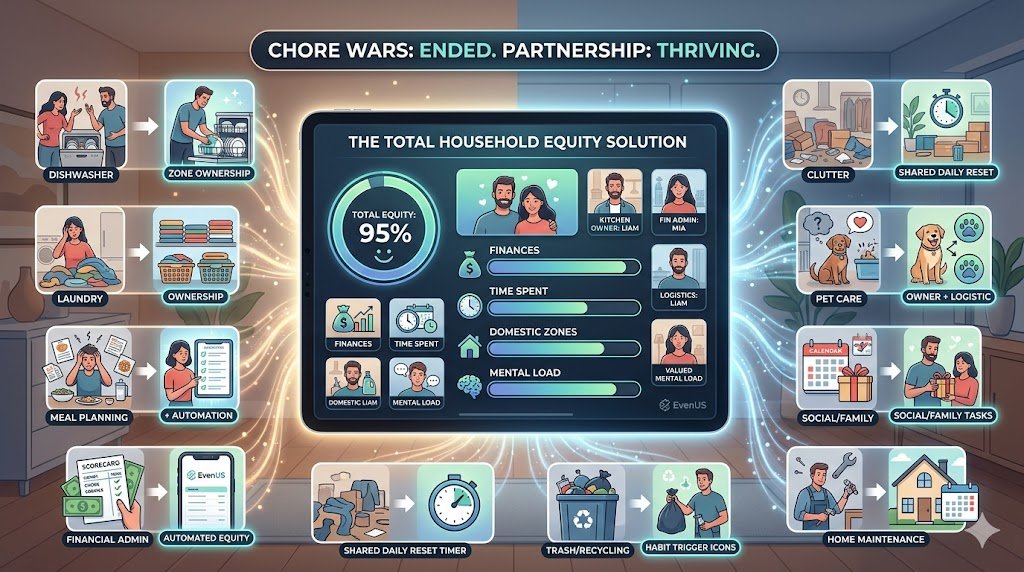
The Chore Wars- In the early stages of a relationship, cohabitation feels like a sleepover with your favorite person. But as the years progress and the complexities of life multiply, the romantic ideal of “building a life together” often devolves into a bitter, silent standoff over a damp sponge left in the kitchen sink.
When a couple finds themselves in a screaming match over who was supposed to take out the recycling, they are rarely arguing about the physical garbage. They are arguing about respect, the burden of invisible labor, and the exhausting feeling of being taken for granted by the person who is supposed to be their partner. In a modern dual-income household, the traditional “roommate model” of splitting tasks 50/50 is not just inefficient; it is actively destructive to romance.
To protect your partnership, you have to understand the psychology of why we fight over chores, identify the specific tasks that trigger the most resentment, and replace manual scorekeeping with automated equity.
The Psychology of the Household Scoreboard
Before addressing the specific chores, it is critical to understand why the 50/50 split fails. The human brain is wired with a cognitive glitch called Availability Bias. You are intimately aware of every dish you wash, every floor you sweep, and every stressful doctor’s appointment you schedule. Because you lived through the effort, that labor is highly “available” to your memory.
Conversely, you only see a fraction of your partner’s effort. You do not feel their mental fatigue or see the small logistical fires they extinguish while you are out of the room. Consequently, both partners constantly feel like they are doing 70% of the work.
Furthermore, traditional chore charts ignore the Mental Load—the cognitive labor of anticipating needs, identifying solutions, and monitoring outcomes. The partner who physically drives the car to the mechanic gets the “credit” for the chore, but the partner who noticed the mileage, researched the shop, and booked the appointment did the exhausting cognitive labor. When this invisible work goes unvalidated, resentment metastasizes.
The solution is to transition from micro-managing individual tasks to establishing Zones of Ownership. By treating your home less like a dorm room and more like a well-run organization, you can eliminate the friction.
The 10 Breakup-Inducing Chores (And The Equity Solutions – The Chore Wars )
1. The Dishwasher Tetris and Kitchen Reset
Why it causes fights: The kitchen is the high-traffic heart of the home, requiring maintenance multiple times a day. Fights stem from differing methodologies (the “right” way to load the dishwasher) and timing. One partner feels like an unappreciated line cook; the other feels constantly micromanaged. The Solve: Implement strict Zone Ownership. If one partner owns the “Kitchen Zone,” they own the meal planning, the cooking, and the cleanup strategy. They have absolute autonomy over how the dishwasher is loaded, and the other partner must relinquish control. If you prefer to split the kitchen, adopt the “I cook, you clean” rule, but with a strict SLA (Service Level Agreement): the cleaner must execute the reset within an hour of the meal ending to prevent the “lingering mess” anxiety that plagues the cook.
2. The Laundry Limbo
Why it causes fights: Laundry is a deceptive, multi-step project (sort, wash, dry, fold, put away). The trap is sprung when one partner does the physical wash, but leaves a damp pile in the machine to mildew, or leaves a mountain of clean clothes on the bedroom chair for a week, forcing the other partner to live in visual chaos. The Solve: Abandon the concept of shared laundry. Wash your own clothes. By separating personal laundry entirely, you remove the friction of shrunk sweaters, ruined fabrics, and unfolded shirts. For shared household items like towels and bedsheets, assign complete end-to-end ownership to one partner as part of their broader household Zone.
3. Meal Planning and the Grocery Run
Why it causes fights: This is the ultimate trap of the Mental Load. The physical act of pushing a cart through a grocery store is relatively easy. The exhausting labor is taking inventory of the pantry, anticipating dietary needs, and figuring out what to feed the household for the next five days. When one partner says, “Just tell me what to buy,” they are forcing the other to do 100% of the cognitive labor. The Solve: The partner who executes the grocery run must also own the list. However, you must automate the inputs. Use a shared digital list via a smart home speaker or app. When anyone uses the last of the milk, they are required to add it to the digital list immediately.
4. Bathroom Deep Cleaning
Why it causes fights: This conflict arises from differing baseline standards of hygiene. Partner A might believe a quick wipe of the mirror and counter is sufficient, while Partner B cannot biologically relax until the shower grout is scrubbed with bleach. The Solve: Establish a Minimum Viable Standard. Sit down during a neutral time and define exactly what “clean” means for your shared spaces. If Partner B’s standard is significantly higher than the agreed-upon baseline, Partner B must own that Zone without resentment, or the couple must agree to outsource this specific task to a cleaning service, funding it proportionally from their incomes.
5. Financial Administration and Paying Bills
Why it causes fights: Managing the budget, remembering property tax due dates, and tracking shared expenses is highly stressful, invisible work. For modern couples who keep separate bank accounts, the partner managing the math often feels like a collection agent, constantly sending Venmo requests for utility bills or rent. It creates a transactional, unromantic dynamic. The Solve: Move away from manual spreadsheets. You need an automated, neutral third party to manage the “Virtual Ledger.” This is where couples must rely on dedicated financial equity tools that automatically calculate income-proportional splits and track shared expenses without the need to constantly “settle up” manually.
6. The Clutter Creep
Why it causes fights: Clutter is visual noise. Mail piling up on the island, shoes kicked off by the door, empty Amazon boxes lingering in the hallway. The partner with a lower tolerance for visual noise usually ends up silently picking up after the other, breeding a deep, quiet resentment. The Solve: Implement the 15-Minute Daily Reset. Set a timer for 15 minutes every single evening where both partners tackle the shared living spaces simultaneously. It is not deep cleaning; it is simply resetting the house to its baseline state. When you execute this together, neither person feels like the default maid.
7. Pet Care Logistics
Why it causes fights: You both adore the dog, but the daily, unrelenting grind of early morning walks, scheduling vet appointments, and reordering heartworm medication often falls disproportionately on one person’s shoulders. The Solve:Split the physical labor from the cognitive labor. If Partner A owns the physical task of the daily morning and evening walks, Partner B owns the cognitive “Pet Logistics” Zone—meaning Partner B is entirely responsible for researching food brands, tracking vaccination schedules, and booking the groomer.
8. The Social Calendar and Kids’ Logistics
Why it causes fights: Remembering birthdays, buying gifts for in-laws, RSVPing to weddings, and managing the chaotic overlaps of children’s schedules drains massive amounts of cognitive energy. When you are managing a household with three children—for instance, trying to advocate for twins to be placed in different school sections while simultaneously tracking a six-year-old’s extracurriculars—the mental load is paralyzing. The Solve: Divide and conquer by bloodline and domain. Partner A is entirely responsible for buying gifts, calling, and scheduling events with Partner A’s family; Partner B handles theirs. For children’s logistics, assign specific domains. One partner handles all school administration (emails, parent-teacher conferences, section requests), while the other handles all medical and extracurricular logistics.
9. Taking Out the Trash and Recycling
Why it causes fights: It is the ultimate procrastination chore. It quickly devolves into a game of “garbage Jenga”—seeing how much trash can be precariously balanced on top of the can before someone finally caves, gets frustrated, and takes it out. The Solve: Tie the task to a strict Habit Trigger rather than waiting for the bin to reach capacity. For example, the trash goes out every night directly after the kitchen is closed, or every morning on the way out the door to the car. No exceptions, no waiting for it to overflow. It simply becomes an automated physical habit.
10. Scheduling Home Maintenance
Why it causes fights: Changing HVAC filters, scheduling the plumber, cleaning the gutters—these are low-frequency, high-importance tasks. Because they don’t happen daily, they are easily forgotten. When they are ignored, it usually results in an emergency that costs the household thousands of dollars, leading to intense blame. The Solve: Treat the physical structure of your home like a business asset. Create a recurring, shared digital calendar strictly for home maintenance. When a calendar alert pops up (e.g., “Winterize sprinkler system”), the designated Zone owner executes it immediately.
The Automated Solution: Stop Keeping Score
To truly eliminate the chore wars, you must apply a “Zapier-like” automation mindset to your home life. You need systems that trigger in the background without requiring constant human monitoring, nagging, or manual data entry.
When you track chores on a fridge whiteboard, you are tracking physical tasks. But a successful partnership requires tracking Total Relationship Equity—a combination of financial contribution, physical time spent, and the invisible mental load.
This is the foundational philosophy behind the EvenUS app. Built specifically for modern couples who want to maintain their independence while building a fair partnership, EvenUS operates as your shared financial and logistical brain. It allows you to ditch the spreadsheets and the chore charts by calculating your dynamic, income-proportional ratios in real-time. More importantly, it is the only platform that allows you to log domestic work and household management alongside your finances, factoring your logistical effort into a Total Fairness Score.
When a neutral system handles the math and validates the invisible effort, money and chores stop being a source of conflict. You can finally stop acting like roommates keeping a scoreboard, and start acting like partners building a shared future.
End the chore wars for good. Stop fighting over the dry-erase board and start managing your relationship’s equity. Automate the mental load, track your shared expenses, and validate the invisible work with the ultimate toolkit for modern couples.
👉 Build your balanced partnership today at EvenUS
Availability Bias in Partnerships:
- Link: Egocentric Biases in Availability and Attribution (Journal of Personality and Social Psychology)