
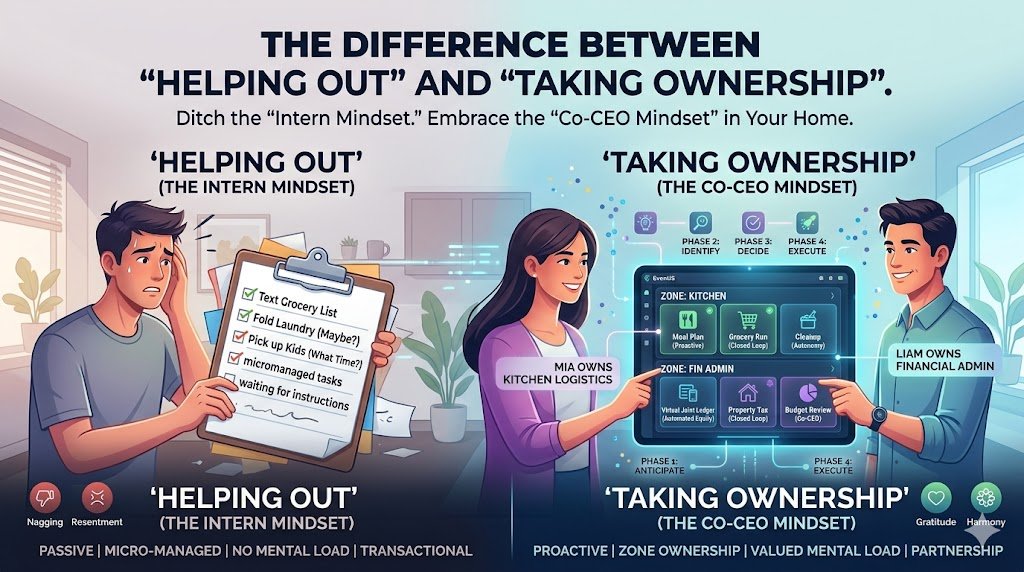
In the lexicon of modern romantic relationships, few phrases are as deceptively dangerous as, “Let me know how I can help.” On the surface, this sentence sounds supportive, loving, and entirely egalitarian. It is usually spoken by a partner who genuinely wants to contribute and alleviate stress. But underneath that seemingly harmless offer lies a foundational misunderstanding of household equity. When you offer to “help” your partner run the home, you are unconsciously declaring that the household is their primary responsibility, and you are merely stepping in as a temporary assistant, a favor-doer, or an emergency backup.
This subtle linguistic shift is the root cause of profound resentment in dual-income households. The partner receiving the “help” does not feel supported; they feel isolated at the top of a domestic hierarchy they never asked to lead. If you want to protect your partnership from the slow, corrosive erosion of burnout and scorekeeping, you have to understand the critical distinction between “helping out” and “taking ownership”—and learn how to permanently shift your dynamic toward the latter.
The Difference Between “Helping Out” and “Taking Ownership” in a Modern Partnership
1. The Trap of “Helping Out” (The Intern Mindset)
When a partner operates in the “helping out” mindset, they are essentially acting like an intern in their own home. An intern is usually well-meaning, eager to please, and perfectly capable of executing physical tasks. However, an intern requires a manager to tell them exactly what to do, when it needs to be done, where the supplies are kept, and how the final product should look.
What “Helping Out” Sounds Like:
- “I’m heading to the grocery store, text me a list of what we need.”
- “Do you want me to fold this basket of laundry?”
- “Just tell me what time I need to put the kids to bed tonight.”
- “What do you want me to make for dinner?”
The fatal flaw of “helping out” is that it completely ignores the heaviest burden in a household: The Mental Load. By asking your partner to delegate a task to you, you are forcing them to perform the exhausting cognitive labor of project management.
When you say, “Text me a grocery list,” you are demanding that your partner mentally inventory the pantry, anticipate the dietary needs for the week, formulate a meal plan, and type out the instructions. You may be doing the physical labor of walking down the aisles and swiping the credit card, but they are still carrying the mental weight of keeping the family fed. You haven’t removed a task from their plate; you have just changed their job title from “Cook” to “Logistics Manager.” Over time, the partner managing the intern becomes paralyzed by decision fatigue, leading to the common, exhausted refrain: “It’s honestly just easier if I do it myself.”
2. What “Taking Ownership” Actually Means (The Co-CEO Mindset)
Taking ownership means abandoning the intern role and operating as a Co-CEO. A Chief Executive Officer does not wait to be delegated to; they look at the landscape of their organization, anticipate upcoming needs, and manage projects from inception to final completion.
When you take ownership in a relationship, you absorb both the physical execution and the invisible cognitive labor—the planning, the researching, the deciding, and the monitoring. You take a specific domain off your partner’s plate entirely, so deeply and thoroughly that they never even have to think about it again.
What “Taking Ownership” Sounds Like:
- “I noticed we’re getting low on staples, so I inventoried the fridge, made a meal plan for the next four days, and I’m heading to the store now.”
- “I saw the laundry basket was full, so I washed, dried, and put everyone’s clothes away.”
- “I’ve got the kids’ bedtime routine handled from start to finish tonight; go read a book and relax.”
- “I noticed the car is making a weird noise; I researched mechanics, booked an appointment for Thursday, and arranged a ride home.”
Consider the sheer complexity of managing a modern family. When you are trying to navigate the overlapping logistics of a growing household—like coordinating with a school to ensure your twins are placed in different class sections, while simultaneously tracking a six-year-old’s pediatric appointments and extracurricular schedules—simply “helping out” is a drop in the ocean. A complex household does not need an assistant; it requires a capable partner who claims their zones and owns them completely.
3. The Science of Ownership: The Four Phases of Cognitive Labor
To truly transition from a helper to an owner, it helps to understand the sociological anatomy of a chore. Research into domestic inequity, notably the work of Harvard sociologist Allison Daminger, reveals that household tasks are not single actions, but four-part processes.
To take true ownership, you must execute all four phases:
- Anticipating: This is the act of actively scanning your environment for upcoming needs before they become emergencies. (Example: Noticing that the weather is turning cold and the children will soon need winter coats.)
- Identifying Options: This is the research phase. (Example: Going online to see which brands make durable coats, checking what is currently on sale, and looking up the children’s current sizes.)
- Deciding: Making the executive call without requiring a committee meeting or asking for permission. (Example: Choosing the navy blue coats in size 6 and 8, and finalizing the purchase.)
- Executing & Monitoring: Doing the physical task and ensuring the loop is fully closed. (Example: Unboxing the coats when they arrive, making sure they actually fit the kids, and handling the return process if they don’t.)
If you only step in at Phase 4 (e.g., your partner hands you a box and says, “Can you drop this return off at the post office?”), you are merely helping. If you handle Phases 1 through 4, you are owning. True equity is achieved when both partners are taking full, four-phase ownership of their respective domains.
4. Rewiring the Dynamic: Banning the “Helper” Vocabulary
Language dictates reality. The fastest way to change your household dynamic is to change your vocabulary. By consciously altering how you speak about domestic labor, you rewire your brain to look for systemic solutions rather than waiting for discrete, micro-managed tasks.
Phrases You Must Retire Immediately:
- “What can I do to help you?” (Implies the burden belongs to them).
- “Just tell me what you need me to do.” (Forces them to project manage).
- “Did you want me to…” (Places the burden of decision-making on them).
- “I’m babysitting the kids tonight.” (You cannot babysit your own children; you are parenting).
Phrases You Must Adopt:
- “I am taking care of [X] today.” (Asserts capability and removes their need to monitor).
- “I own the kitchen cleanup tonight, don’t even think about it.” (Sets clear boundaries of ownership).
- “I’ve mapped out the schedule for the weekend, here is the plan.” (Demonstrates Phase 1 and 2 cognitive labor).
- “Leave that to me; consider it done.” (Offers ultimate peace of mind).
5. Systematizing Ownership with EvenUS
The transition from “Helper” to “Co-CEO” is incredibly difficult—if not impossible—if you are still trying to manage your shared lives via chaotic group texts, scattered post-it notes, or a dry-erase board on the refrigerator. To make ownership sustainable, couples need a shared logistical brain that exists outside of either partner’s head.
This is precisely why the EvenUS app was engineered. It is not a task-delegation app built for an “intern”; it is a comprehensive management dashboard designed explicitly for couples acting as Co-CEOs of their shared life.
- Zone Management over Task Lists: Instead of assigning out fifty micro-chores a week, EvenUS encourages partners to claim total ownership over specific domestic zones (e.g., Kitchen Logistics, Pet Care, Financial Admin). This validates both the physical execution and the invisible mental load required to run those domains.
- Automating the Math: Ownership extends to finances. For couples who prefer separate bank accounts, manually settling up shared bills creates a “Venmo Roommate” dynamic. EvenUS acts as a virtual joint ledger, calculating dynamic, income-proportional ratios so both partners contribute their fair share without having to ask each other for money.
- The Total Fairness Score: By quantifying the logistical effort, time spent, and proportional financial contributions, EvenUS provides a neutral, objective view of who is owning what. It finally makes the invisible work visible and measurable.
- Eliminating the Manager: Because the EvenUS system tracks recurring needs, shared expenses, and household zones autonomously, it removes the need for one partner to act as the “nag.” The app manages the system, so you can focus on managing your relationship.
You did not get married to become a project manager, and you did not commit to a life partnership to be someone’s assistant. The health of your relationship depends on mutual respect, and respect is built on shared responsibility. Stop helping out, start taking ownership, and watch the resentment melt away as you build a truly equitable future together.
Ready to ditch the intern mindset and become a Co-CEO? Stop waiting for instructions and start building true relationship equity. Move your household management off the group text and into a system designed for modern partners. Track your shared finances, validate the mental load, and master your zones of ownership.
👉 Start managing your shared life today at EvenUS
Shifting from an “intern” to a “Co-CEO” requires more than just checking off a list of chores; it requires deep emotional accountability. When logistical systems fail or miscommunications happen, the instinct to point fingers is incredibly strong. However, true partnership means prioritizing systemic solutions over personal scorekeeping. For a deeper look into breaking this toxic cycle, I highly recommend exploring how to stop playing the blame game and take responsibility in your relationship
. This fundamental shift in emotional perspective is the bedrock of lasting household equity.