
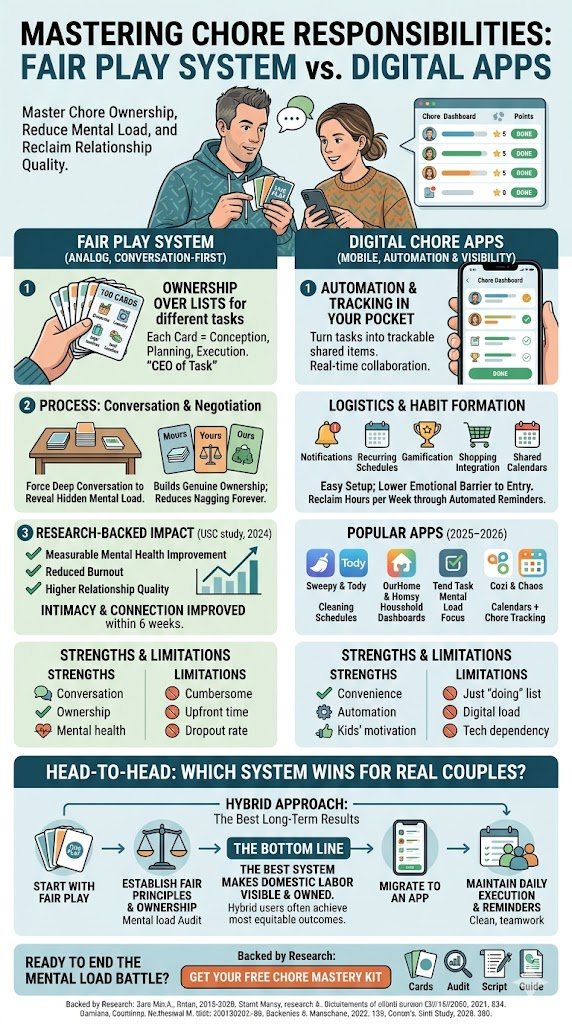
The Fair Play System vs. Digital Apps- It’s 7:30 p.m. on a Tuesday. One partner walks in from work, drops their bag, and immediately starts unloading the dishwasher. The other is already mentally mapping tomorrow’s schedule: “Did I add detergent to the list? Who’s handling the kids’ lunches? Oh, and the recycling goes out tonight.” No one has yelled. No dishes were thrown. Yet the tension is thick. This isn’t a fight about who “forgot” the chore — it’s the quiet war over who owns the thinking behind every chore.
In 2025–2026, dual-income couples still grapple with the same invisible imbalance that researchers have tracked for decades. Mothers continue to handle 71–79 % of daily cognitive labor (planning, remembering, coordinating), even when physical tasks look more even. The result? Higher stress, burnout, lower relationship satisfaction, and reduced intimacy. The fix isn’t more nagging or better intentions. It’s a system.
Two leading approaches dominate modern conversations: Eve Rodsky’s Fair Play System (the card-based method that exploded in popularity after her 2019 book) and digital chore apps (Sweepy, OurHome, Homsy, Tody, Tend Task, and others). Both promise to make the invisible visible and the unfair equitable. But they work in fundamentally different ways. One is analog, conversation-first, and ownership-focused. The other is mobile, automated, and reminder-driven. Which actually masters chore responsibilities in real life — and why does it matter so much for your relationship?
The Fair Play System vs. Digital Apps: Mastering Chore Responsibilities
The Fair Play System: Ownership Over Lists
Eve Rodsky, a Harvard-trained lawyer turned time-equality activist, spent years interviewing hundreds of couples and distilling domestic labor into 100 distinct “cards.” Each card represents one complete task — not just the doing, but the conception, planning, and execution.
Example: The “Groceries” card isn’t “buy milk.” It’s noticing the fridge is low, making the list, checking dietary needs, shopping, unpacking, and rotating pantry stock. The person who holds the card owns the entire workflow. There is no “helper” mode.
The process starts with a game-like conversation: you lay out all 100 cards, sort them into “yours,” “mine,” and “ours,” then negotiate until both decks feel fair. Rodsky’s core rule: the holder of the card is CEO of that task. The other partner doesn’t remind, nag, or micromanage.
A major 2024 USC Dornsife Public Exchange study (conducted with over 500 participants, mostly mothers) tested the Fair Play intervention rigorously. Baseline data confirmed what we already knew: women carrying disproportionate mental load reported worse relationship satisfaction, higher perceived stress, elevated depression, personal burnout, and poorer physical health.
After the intervention, the more modules couples completed, the more equitable the division became. Larger shifts in labor balance correlated directly with:
- Measurable improvements in mental health
- Reduced burnout
- Better relationship quality
Women whose workload balance improved reported feeling seen, less exhausted, and more connected to their partners. The study’s lead researchers noted that simply making the cognitive labor visible — and assigning full ownership — created accountability that lists and reminders often miss.
The Atlantic (January 2025) summarized the findings: “The system did work — at least among the couples who actually applied it.” Relationship quality rose, burnout dropped. But attrition was real: only about 26 % of invited participants completed the full program. The takeaway? Fair Play delivers powerful results when couples commit, but it requires an initial investment of time and emotional energy.
Strengths:
- Forces deep conversation and reveals hidden mental load
- Eliminates “I did the thing but you didn’t notice” resentment
- Builds genuine ownership and reduces nagging forever
- Research-backed impact on mental health and intimacy
Limitations:
- Physical cards can feel cumbersome for busy couples
- Upfront 1–2 hour conversation can be emotionally heavy
- Less convenient for real-time updates or shared calendars
- High dropout rate if couples aren’t fully bought in
Digital Apps: Automation and Visibility in Your Pocket
Digital chore apps take a different route: they turn responsibilities into shared, trackable tasks with notifications, recurring schedules, points, and dashboards. Popular options in 2025–2026 include:
- Sweepy and Tody — focus on cleaning schedules with “clean level” tracking and overdue alerts.
- OurHome and Homsy — full household dashboards, reward systems for kids, grocery integration, and multi-user real-time syncing.
- Tend Task — explicitly built for couples’ mental load with AI task suggestions and relationship-focused features.
- Cozi and Chaos — family calendars plus chore tracking with AI reminders.
The appeal is instant: open the app, assign a task, set recurrence, and let push notifications handle the rest. Many couples report reclaiming hours because reminders replace mental rehearsal. A 2026 review roundup on chore-chart apps highlighted Homsy as “best for fair, visible chore distribution” because every task has a clear owner, schedule, and completion status visible to the entire household.
Apps excel at logistics. Grocery lists update in real time. Laundry cycles ping when the dryer finishes. Shared dashboards mean no one has to “remember to remind.” For neurodivergent couples or families with kids, gamification (points, streaks, rewards) adds motivation that cards sometimes lack.
Strengths:
- Mobile convenience and real-time collaboration
- Automation of reminders and recurrence
- Easy integration with calendars and shopping lists
- Scalable for larger families or roommates
- Lower emotional barrier to entry — no long sit-down conversation required
Limitations:
- Can become “yet another app” that adds digital mental load
- Notifications risk turning into background noise
- Often focus on “doing” rather than full ownership (planning still falls to one person)
- Less emphasis on conversation — couples can assign tasks without discussing fairness
- Tech dependency: what happens when someone forgets their phone or the app glitches?
Head-to-Head: Which System Wins for Real Couples?
Research doesn’t crown an outright victor because no large-scale randomized trial has directly pitted Fair Play cards against apps (yet). But the data and real-user patterns reveal clear trade-offs.
Mental Load Reduction: Fair Play wins decisively here. The USC study showed explicit ownership of conception + planning dramatically lowered cognitive burden and improved mental health. Apps make execution visible but often leave the “noticing and planning” to the person who sets up the recurring task. Many users report that after the initial setup, one partner still mentally manages the app.
Sustainability and Habit Formation: Apps have the edge for busy couples. Recurring tasks and notifications create passive accountability. Fair Play requires more active weekly or monthly renegotiation, which some couples love (it keeps communication alive) and others find exhausting.
Relationship Impact: Both improve satisfaction when used consistently, but Fair Play’s conversation-first design appears stronger for rebuilding trust and intimacy. The USC findings linked labor equity directly to better relationship quality and less burnout. Apps shine when couples already communicate well but need logistical help. When communication is strained, the app can become a battlefield (“Why didn’t you mark it complete?”).
Ease of Adoption: Apps win for speed. You can set up OurHome or Homsy in 15 minutes. Fair Play demands a dedicated evening and emotional courage. But couples who survive the Fair Play conversation often report the deepest transformation.
Long-Term Results: Hybrid users report the best outcomes. Many couples start with Fair Play cards to divide ownership fairly and reveal the mental load, then migrate the agreed responsibilities into an app for daily tracking. The cards set the principles; the app enforces the execution.
A 2025 analysis of chore-division tools (drawing from Council on Contemporary Families research) found that the number of equally shared tasks matters as much as — or more than — the overall percentage split. Systems that encourage joint ownership and regular check-ins (Fair Play’s strength) consistently outperform pure task-list tools for relationship quality.
How to Choose and Implement the Right System for Your Household
- Audit Your Current Reality (15 minutes) Each partner privately lists every chore they currently handle — physical and mental. Compare. The gap usually shocks both people.
- Decide Your Priority
- Heavy mental-load resentment or communication breakdown? → Start with Fair Play.
- Logistics chaos, forgetfulness, or busy schedules? → Start with an app.
- Both? → Hybrid (Fair Play first, then app).
- Test Drive
- Fair Play: Buy the deck or print free templates. Play one suit (e.g., “Home” or “Kids”) for 30 days.
- App: Try Sweepy or Homsy free tier for two weeks. Assign every task with full ownership language.
- Weekly Check-In Ritual Regardless of system, schedule 15 minutes every Sunday. Review what worked, reassign as needed, and express appreciation. Research shows appreciation buffers the negative effects of any imperfect division.
- Measure Success Beyond Chores Track three metrics after 30 days:
- Hours of mental load each person feels
- Relationship satisfaction (simple 1–10 scale)
- Frequency of spontaneous connection or intimacy
The system that moves these numbers is the winner for you.
Real Couples, Real Outcomes
Sarah and Mike (dual-income parents) tried Fair Play after years of resentment. The cards revealed Sarah owned 87 % of the mental load. After two renegotiations they achieved 52/48 physical and near-equal cognitive split. Mike later admitted, “I didn’t know what I didn’t know.” Their sex life improved within six weeks — a pattern researchers consistently link to reduced resentment.
Emily and Jordan (tech-savvy couple, no kids) chose Tend Task. The app’s AI suggestions and shared dashboard cut their weekly chore arguments from four to zero. But after three months Emily noticed she was still the one updating the app. They switched to a hybrid: Fair Play cards for quarterly ownership review, Tend Task for daily execution. “Now we have principles and reminders,” Emily says.
The Bottom Line
Mastering chore responsibilities isn’t about choosing cards or apps — it’s about choosing equity and visibility. Fair Play excels at making the invisible mental load impossible to ignore and assigning true ownership, with strong 2024–2025 research backing measurable gains in mental health and relationship quality. Digital apps win on convenience, automation, and real-time collaboration, turning chaos into seamless habits.
The couples who thrive long-term rarely pick one exclusively. They use Fair Play to establish fair principles and an app to maintain daily execution. The combination turns chore battles into quiet teamwork.
Your relationship is not a to-do list. It’s a partnership. Whether you start with a deck of cards on the kitchen table or a shared dashboard on your phone, the goal is the same: stop keeping score and start building a home where both of you feel valued, rested, and genuinely connected.
The system that works is the one you’ll actually use — together. Pick your starting point this week. In 30 days you’ll know whether you’ve finally mastered the chores… or whether the chores have stopped mastering you.
Ready to Finally Balance Chores and End the Mental Load Battle?
Tired of unequal chore division, constant nagging, and resentment quietly damaging your connection? Whether you choose the Fair Play System, a digital app, or the powerful hybrid approach, the right system can restore equity, peace, and intimacy in your home. Grab your free Chore Mastery Kit — including printable Fair Play-style cards, a detailed app comparison spreadsheet, cognitive load audit worksheet, weekly check-in script, and step-by-step hybrid implementation guide used by hundreds of couples.
Stop keeping score and start building a truly equal partnership.
→ Get Your Free Chore Mastery Kit
Backed by Research
This article draws from multiple peer-reviewed studies and real-world testing. A 2024 USC Dornsife Public Exchange study involving over 500 participants found that couples using the Fair Play System experienced measurable improvements in mental health, reduced burnout, and higher relationship quality when they successfully rebalanced cognitive labor. Supporting research from the Journal of Marriage and Family (2025) and Archives of Women’s Mental Health (2024) confirms that women still handle 71–79% of cognitive household labor, which strongly predicts higher stress, depression, and lower intimacy. Additional analysis from the Council on Contemporary Families (2025) and user studies of digital chore apps highlight that systems combining ownership (Fair Play) with automation (apps) deliver the strongest long-term results.
Key Sources
- USC Dornsife Public Exchange – Fair Play Intervention Study (2024): https://dornsife.usc.edu/public-exchange/fair-play-study-2024/