
The “Fairness Paradox” – Why Chores Don’t Equal Equality
Mental Load Tracker -In the modern landscape of dual-income households and progressive parenting, most couples enter cohabitation with an explicit agreement: “We will be equal partners.” They split the mortgage 50/50, take turns cooking, and share the bedtime routine. Yet, beneath this veneer of equality, a silent crisis is brewing. One partner—statistically most often the woman—is frequently on the verge of a cognitive breakdown.
The problem isn’t the physical labor of doing the dishes or folding the laundry; it is the Invisible Labor of remembering that the dishes are dirty, that the detergent is running low, and that the guest coming on Friday is allergic to peanuts. This is the Mental Load: the high-level project management required to keep a family ecosystem from collapsing.
The Four Stages of Cognitive Labor
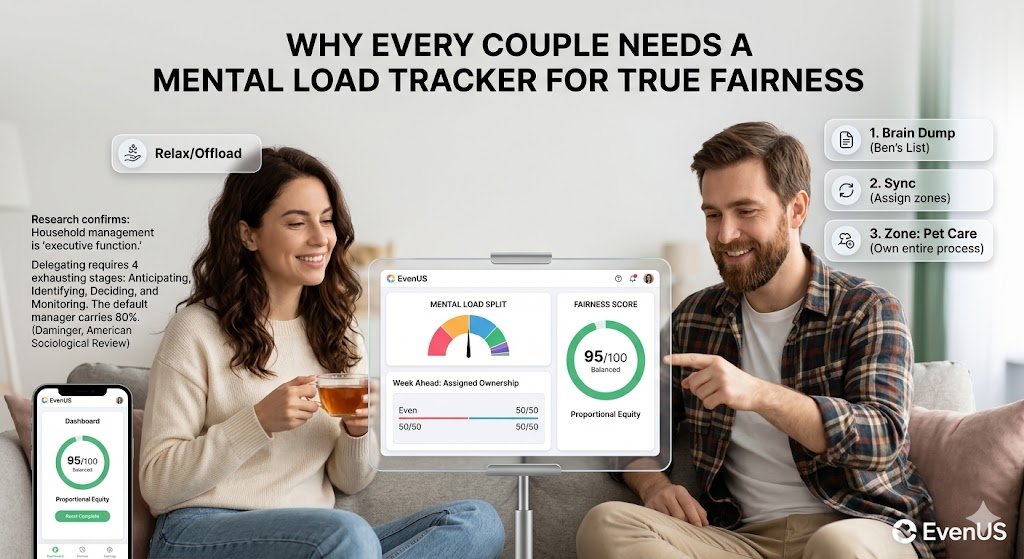
To achieve true fairness, couples must stop trying to balance “tasks” and start balancing “cognitive real estate.”Sociologist Allison Daminger of Harvard University identifies four distinct stages of household labor that explain why simple chore-splitting fails:
- Anticipating: Noticing a need before it becomes an emergency (e.g., “The kids will need winter coats soon”).
- Identifying: Researching the options (e.g., “Which coats are waterproof and on sale?”).
- Deciding: Choosing the path forward (e.g., “I’ll buy the blue one from North Face”).
- Monitoring: Ensuring the task was completed and the outcome was successful.
The “Helper” Trap
Traditional “help” usually only occurs at stage 3 or 4. When a partner says, “I’ll help, just tell me what to do,” they are asking the other person to perform 75% of the cognitive labor for them. They are essentially asking for a project manager to hand them a sub-task.
A mental load tracker forces the “Helper” to see the “Anticipating” and “Identifying” stages, turning them into a Co-Owner. Without this visibility, the partner carrying the load remains in a state of “Executive Exhaustion,” even if the physical chores are split down the middle.
Research Insight: Daminger’s landmark study, “The Cognitive Dimension of Household Labor,” published in the American Sociological Review, found that women perform significantly more of the “anticipating” and “monitoring” stages, even in households that identify as egalitarian. Access the research paper via SAGE Journals
The Zeigarnik Effect – Why Your Brain Can’t “Shut Off”
Have you ever wondered why you feel “tired but wired” at 11:00 PM? You’ve finally sat down, the house is quiet, and yet your heart is racing with a phantom to-do list. This isn’t just “stress”—it is a neurological phenomenon known as the Zeigarnik Effect.
Named after psychologist Bluma Zeigarnik, this principle states that the human brain is hardwired to remember—and obsess over—uncompleted or interrupted tasks more vividly than completed ones. Your brain treats every unfinished household detail as an “Open Loop.”
The “Open Loop” Syndrome
When the family’s logistical data lives solely in your head, your brain is functioning like a computer with 50 browser tabs open. Your subconscious is constantly “pinging” your conscious mind to ensure nothing falls through the cracks:
- “Don’t forget the library books are due tomorrow.”
- “Did you remember to RSVP for that birthday party?”
- “Is there enough gas in the car for the morning commute?”
For the partner carrying the mental load, these loops never truly close. Even when a physical task is finished (like putting the laundry in the dryer), the cognitive task (remembering to move it to the basket, fold it, and put it away) remains active. This prevents the nervous system from entering a state of deep rest, leading to chronic insomnia, “brain fog,” and a sense of constant hyper-vigilance.
The Solution: Cognitive Offloading
A mental load tracker acts as an External Hard Drive for your family. By logging a task into a shared, digital system like EvenUS, you effectively “close the loop” in your biological brain.
Research on Cognitive Offloading proves that once we trust an external system to hold information, our brains stop using metabolic energy to store it. This lowers cortisol levels and frees up mental “RAM” for more important things—like creativity, intimacy, and actually being present with your children.
The Scientific Backing: Research published in Scientific Reports explores how humans use external tools to manage collective memory. It concludes that offloading data to a reliable system allows the brain to reallocate energy from “storing” to “processing.”
The “Manager-Employee” Trap – How Logistics Kill Intimacy
Without a neutral tracking system, couples often default into a toxic and exhausting hierarchy: the Manager-Employeedynamic. This is perhaps the most common reason why modern, egalitarian-leaning relationships feel strained despite both partners “trying their best.”
In this trap, one partner (usually the one carrying the mental load) becomes the Project Manager. They are responsible for the vision, the timeline, and the oversight. The other partner becomes the Employee, waiting for instructions, asking “what can I do to help?”, and performing tasks only when prompted.
The Hidden Costs of the Hierarchy
This dynamic is a romance killer for three specific reasons:
- The “Nag” Narrative: The Manager is forced to “monitor” (the 4th stage of labor). When they follow up on a task, they are labeled a “nag.” This creates a cycle of resentment where one person feels like a drill sergeant and the other feels like a pestered teenager.
- Decision Fatigue: The Manager suffers from a depletion of executive function. By the time the kids are in bed, they have made so many micro-decisions that they have no mental energy left for connection or intimacy.
- Loss of Agency: The Employee partner often feels disconnected from the home. Because they don’t own the “Anticipating” or “Identifying” stages, they never develop a sense of mastery or pride in the household’s success. They are just “helping out” in someone else’s system.
Shifting to Co-Ownership
A mental load tracker like EvenUS removes the need for a human Manager. When the data is objective and visible on a shared dashboard, the “nagging” stops.
The system becomes the “Source of Truth.” If the dog needs feeding or the utility bill is due, the app provides the prompt, not the partner. This restores the horizontal relationship of two adults working toward a common goal. It allows the partner who was the “Employee” to see the full picture and step up as a Proactive Partner, and it allows the “Manager” to finally step down and just be a partner again.
Research Connection: Sociological research into “Emotional Labor” (Arlie Hochschild) highlights that the work of managing a partner’s moods and avoiding conflict (often by not “nagging”) is an additional layer of labor that further exhausts the household manager. Read the foundational research on Emotional Labor
From “Tasks” to “Zones” – The Power of Total Ownership
One of the most transformative shifts a couple can make is moving away from splitting individual, micro-tasks and toward owning entire “Zones.” In a traditional household, chores are often traded like commodities: “I’ll do the dishes if you fold the laundry.” While this seems fair on the surface, it leaves the mental load of both tasks—remembering to start them, checking if they are done, and ensuring there’s enough soap—floating in the air, usually landing back on the “Default Manager.”
A mental load tracker like EvenUS facilitates the move to Total Ownership. A “Zone” is a broad category of household life (e.g., “The Morning Routine,” “Pet Maintenance,” or “School Communications”). When a partner owns a Zone, they don’t just “help” with a task; they own the entire cognitive process.
The Anatomy of a “Zone”
If you own the “Pet Zone,” your partner should never have to think about a dog bowl or a vet appointment again. Total ownership means you are responsible for all four stages of labor:
- Anticipating: Noticing the dog’s vaccinations are due next month.
- Identifying: Finding a vet that fits the family schedule and budget.
- Deciding: Booking the appointment and choosing the treatment plan.
- Monitoring: Administering the follow-up meds and tracking the recovery.
The Psychological Benefits of Autonomy
This shift creates two powerful results that save relationships:
- For the Partner Giving Up the Zone: It provides the greatest gift of all—Mental Space. The “open loop” associated with that category is finally closed. They don’t have to “check in” or “remind” because they trust the owner and the system.
- For the Partner Taking the Zone: It provides Autonomy and Mastery. Instead of being an “Employee” taking orders, they are the “Lead” on a project. They have the agency to do it their way, according to the agreed-upon Minimum Standard of Care (MSC).
The “Minimum Standard of Care” (MSC)
To prevent the Manager from “swooping in” and re-doing the work (Maternal Gatekeeping), couples must agree on what “done” actually looks like. If the “Kitchen Zone” owner’s MSC includes wiping the counters but not the baseboards, and both partners agree to that standard, the non-owner is strictly forbidden from “monitoring” or criticizing the result. This creates the trust necessary for the mental load to actually transfer.
The Research Grounding: Research into Self-Determination Theory suggests that autonomy is one of the three basic psychological needs for human motivation. When partners have total ownership over a “Zone,” they are more intrinsically motivated to succeed than when they are simply “helping out.” Explore the research on Autonomy and Motivation
Section 5: EvenUS – More Than Just a To-Do List
The 21st-century household is too complex to be managed by one person’s memory or a static paper list. Most productivity apps (Asana, Trello, Todoist) are designed for corporate teams or individuals. They don’t account for the emotional nuances, the financial interdependencies, or the unique “Default Parent” dynamics of a romantic relationship. EvenUS was built specifically as a Household Operating System to solve the mental load crisis.
It turns the abstract psychological principles of cognitive offloading and total ownership into a daily, frictionless habit.
Key Features for True Fairness
Unlike a simple checklist, EvenUS is designed to facilitate a partnership of equals through three core technological shifts:
- Visual Cognitive Split (The Mental Load Dashboard): EvenUS doesn’t just show that the dishes were washed; it visualizes the “Thinking” split. Our dashboard shows who is Anticipating and Deciding across the home. When you can see a real-time graph showing that one partner is owning 15 “Zones” while the other is owning 4, the conversation moves from a subjective argument to a data-driven logistical adjustment.
- Automated Nudges (The “Nagging” Antidote): The app handles the reminders. If a bill is due or a vet appointment is approaching, the system triggers the notification to the Zone Owner. This eliminates the need for the other partner to be the “Human Alarm Clock,” effectively ending the “Manager-Employee” cycle and restoring the horizontal relationship.
- The Fairness Score (Integrated Finances & Labor): EvenUS is the first platform to integrate your shared finances with your household contributions. It calculates a holistic “Fairness Score” that validates the invisible work of the heart and mind, ensuring that both partners feel their total contribution—monetary and logistical—is seen and valued.
The Sunday Reset Hub
To ensure the system stays current, EvenUS provides a dedicated space for your Weekly Sunday Reset. This 15-minute guided sync allows couples to:
- Perform a joint “Brain Dump” to clear “Open Loops.”
- Audit and “Trade” Zones based on the upcoming week’s work demands.
- Sync the family ledger to prevent “Financial Surprises.”
By externalizing the family operating system to a neutral, third-party platform, you are not just getting organized; you are performing a clinical intervention on your relationship’s health. You are reclaiming your mental “RAM” and rebuilding your home on a foundation of visibility and trust.
The Scientific Conclusion: Research on Cognitive Offloading proves that using reliable external tools allows the brain to reallocate its metabolic energy from “storing” to “processing” and “emotional regulation.” By using EvenUS, you are literally making your brain more efficient. Read the research on Cognitive Offloading